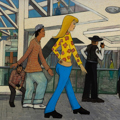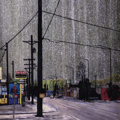






Click on an image to enlarge.
To hear from Anchorage Museum staff and artist Duke Russell, click play below.
Hi, my name is Heather McClain, and I serve as a Senior Archivist for the Archives and Library at the Anchorage Museum. We steward over 800,000 images and 14,000 books, including photographs from the Ward Wells Collection featured in this exhibition.
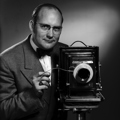
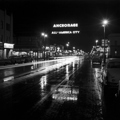
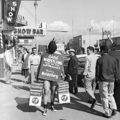
Ward Wells was a professional photographer from when he arrived in Alaska in 1946 until he passed in 1982. The Ward Wells Collection consists of about 150,000 negatives that were taken throughout his career. For over three decades, Wells documented life across Alaska, from Fur Rendezvous and statehood celebrations to the aftermath of the 1964 earthquake and climate change in remote communities. His photographs appear in magazines, such as Life and Time, and in national broadcast TV, offering a vivid visual record of Alaska in the mid-20th century.
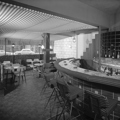
The Ward Wells Collection is organized in three series based on the materials and how they were created: the Portrait series, the Commercial series, and the Stock series. This information not only helps us document the collection but also allows us to provide better access for researchers like Duke Russell and the curatorial team when they come in to view the collection for a project. Wells’ photographs are historical documents of a time and a place within a community’s history, connecting our visitors to the stories and memories embedded in the place where we live. And sometimes these memories lead to an exhibition like this.
Aaron:
Hi, my name is Aaron Legget, Senior Curator of Alaska History and Indigenous Cultures here at the Anchorage Museum. Having worked here for over 15 years and on several exhibitions centered around Anchorage, one of the key resources that I call upon when developing content is the Ward Wells Collection. What I find interesting about this collection is the range of his photographs. Some are strictly documentary or commercial in nature and other are a real slice of life or capture quirky elements of Anchorage as it was experiencing rapid growth after World War II.
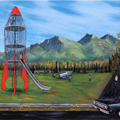
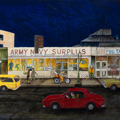
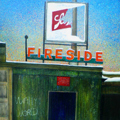
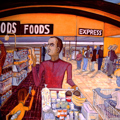
Artist Duke Russell, who like many people moved up here in the mid 1960s and grew up in Anchorage, has often used Wells’ photographs to augment his own memories of Anchorage when creating his artwork. Duke’s paintings often incorporate both the real and the imagined but are always familiar to those of us who have lived for several decades in this place and can see the character of it.
Duke:
It started with this question about Spenard. Why did Spenard have such an attitude? And, I had limited experience with the museum, going to the archive library was new to me. I started just rifling through what they gave me. And I fell upon Ward Wells. And as I looked through his stuff and got to know the staff, they gave me some white gloves and let me loose in the back and I just started going through all the negatives. One thing led to another, you know, if I found something, I would be jonesing to find something else. And I kept at it for six months until I went through the entire collection.
I was looking for some honesty. And I think the Ward Wells Collection, even though it was a lot of commercial photography, it was the first day of these businesses. You know, I think that's very interesting because, you know, who knows what's going to happen. And it's sort of like the birth of community.