








"Seum" - The Learning-Space Museum

An illustration of the Seum concept currently being developed (Photo courtesy of the Ubuntu Lab Project).
Seum - The Learning Space Museum
Conversations with Michael Ratke, co-founder and co-executive director of the Ubuntu Lab Project
by Sandro Debono
Season Two of the ‘Museums in a Climate of Change’ has taken us far and wide as we continue to explore the latest thinking around climate and change. Dr. Sandro Debono, a museum thinker based on the Mediterranean island of Malta, shares his thoughts and reflections about this series of podcasts, now in its second season, featuring conversations with museum professionals from all over the world, co-hosted with Cody Liska.
Our conversation with Michael Radke, co-founder of the Ubuntu Lab, felt less like a formal interview and more like a shared reflection on how people learn and connect. The main idea we explored can be referenced by education and the power museums hold as learning spaces. Michael’s take explores alternative ways of engaging. “We are of people, by people, for people and about people”, Michael replies to one of our questions and “… as we go forward, what I’m already seeing in museology and in museums is a move towards this kind of desire, to engage with the public in a different way.” This stance is framed by the ethical lens of Ubuntu, the African philosophy encapsulated in the phrase - I am because we are.
Ubuntu is an African philosophical concept that emphasises the interconnectedness of human beings. It understands identity not as individual and isolated, but as something formed through relationships, community and mutual care. Rooted in many Sub-Saharan African traditions, Ubuntu foregrounds values such as empathy, dignity, reciprocity and collective responsibility.
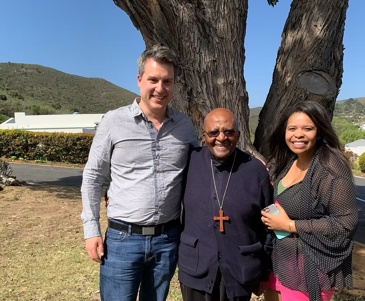
Michael Ratke, Founder and Co-Executive Director at
the Ubuntu Lab Project, with Archbishop Desmond TutuThrough this lens, learning would not just stay with providing answers but would have much more to do with creating the conditions for meaningful conversations to happen. This is where Michael’s museum idea as a learning space comes into focus, also inspired by his encounters with Archbishop Desmond Tutu, the South African Anglican archbishop, global moral leader and one of the most prominent figures in the struggle against apartheid. Mike takes Cody and me through that eventful encounter happening way back. From Tutu, Michael quips, “… I learnt those values of forgiveness, and reconciliation as a process for stopping those cycles of violence and really looking at how we can build things together, even when we don’t agree…”
So what is Michael’s ambition then in real terms?
That has much to do with small human-scale museum spaces that empower learning. Since our conversation with Michael this project now also has a name - Seum. Back then, Seum could be understood in Michael’s museum idea that he shared with us.
Michael advocates for a museum idea that is informed by efforts to “meet people where they are”, and a place that is much less about experts speaking and visitors listening yet more about co-learning, where everyone in the room brings something to the conversation and everyone leaves having learned something new. In short, Michael advocates for small, distributed, neighborhood-scale spaces which draw inspiration from Apple Stores rather than flagship museums, given their advocacy of proximity, reputation and relationship rather than monumentality. We also get a synthesis of Michael’s source of inspiration. “…those stores were originally set to change people’s minds about what an Apple computer could do and be in their lives. But they are really brilliantly set up as community spaces and places of conversation and exploration.”
These ideas are nevertheless well-informed and referenced by theory, too, which he brings up at various points in time throughout our conversation. We get a reference to a philosophical thought informed by radical humanism, for example, which prioritizes human integrity, freedom and dignity, centering the individual over institutions, systems or classes. “… we should be thinking more deeply about what makes us human…” Michael tells us “ … and what our humanity offers us within our role in the world.” Re-centering humanity is the goal, but framed within the remit of an interdependence between people, generations and ecosystems. “ I am who I am through my relationship with others, through who you are,” Michael quips.
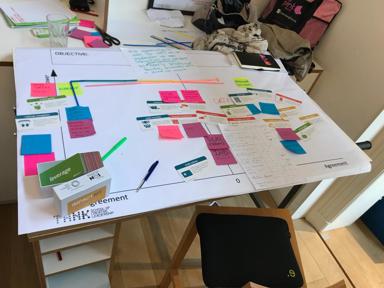
Research and development workshop for the development
of the Seum conceptSuch a museum idea would take the shape and form of small local learning spaces, fostering environments that empower familiarity, trust, and ongoing relationships. Yet, creating safe spaces for dialogue doesn’t mean stepping back entirely. It means being present, attentive, and responsible. This is what Ubuntu means to Michael. “ … Ubuntu lab began with the premise of looking at how do we create learning opportunities and specifically learning spaces and community spaces to hold the kinds of discussions and do the kind of learning that is necessary to understand people in a time where it’s critical to understand people”.
Michael does remind us that museums are deeply trusted institutions. The challenge is not to abandon that trust but to reframe it. Indeed, it is about inviting people into dialogue without losing credibility or care. In a world shaped by climate change, social tension, and rapid change, museums can become places where difficult conversations are held thoughtfully, certainly not avoided. This is not about museums becoming activists. Instead, it is about spaces where conversations are facilitated and made possible. The audience or public that Ubuntu is aspiring to connect to is humanity itself but this global ambition does not take away the intimacy and the directness of the project, apart from the willingness to learn and engage. “So being around young people, being around elders, having the humility to know that you don’t know much and that there’s always more to learn certainly is the way that I stay curious, is just remembering where I fit on the curve of knowledge,” Michael claims.
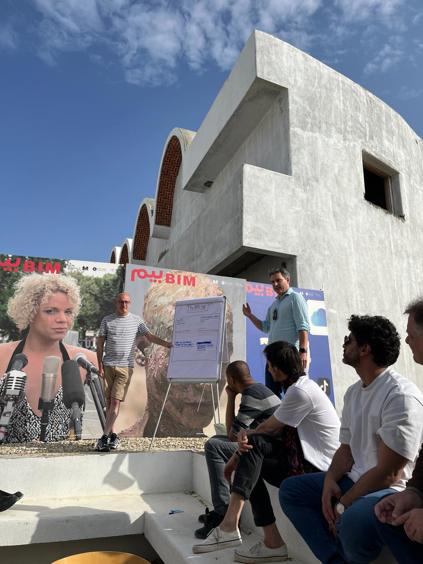
Designing the "Seum" - a new museum learning-space concept
Ubuntu, as Radke presents it, is not a soft or passive idea. It asks museums to be attentive, relational and willing to hold complexity. It also asks of them to foster curiosity as something that adults have been instinctively taught to suppress. Curiosity should be a civic skill, Michael claims, one that museums can protect and rehearse. This reframes museums not as a place of answers but as a space where not-knowing is safe. The challenge for museums inspired by Ubuntu is not only to host conversations, but to connect them to responsibility, without collapsing into prescription.
Since our conversation with Michael Ratke, the Ubuntu Lab has launched Seum, a global network of museums reimagined for today’s communities, located on high streets and in community hubs, with each Seum being a place to explore what it means to be human today. Michael Ratke is now also joined by Kristin Alford as co-executive director. Kristin is the former director of the Museum of Discovery in Adelaide and is one of our guests in this podcast series.
Listen to the podcast in its entirety here.
As you listen to this podcast, you will hear Michael mention ideas, reference concepts and discuss much more in detail. Should you wish to explore further, these are some links to the things that get mentioned:
The Ubuntu Lab
African Philosophy of Ubuntu
Archbishop Desmond Tutu
Mahatma Gandhi
Malcolm X
Tupac Shakur
US Civil Rights Movement
South African Anti-Apartheid Movement
Cross-cultural psychology
Vygotsky’s cone of proximal development