






Museums as Community Living Rooms

Museums as Community Living Rooms
Conversations with Julie Decker, Director and CEO of the Anchorage Museum in Anchorage, Alaska.
by Sandro Debono
Season Two of the ‘Museums in a Climate of Change’ has taken us far and wide as we continue to explore the latest thinking around climate and change. Dr. Sandro Debono, a museum thinker based on the Mediterranean island of Malta, shares his thoughts and reflections about this series of podcasts, now in its second season, featuring conversations with museum professionals from all over the world, co-hosted with Cody Liska.
I must admit that this conversation felt quite close to home, even if I am based in the Mediterranean, guided by all sorts of questions raised by Julie rather than by Cody and I. Those questions, motivated by curiosity and a commitment to go beyond, would guide us to possibilities and futures that the Anchorage has been engaging with from time to time.
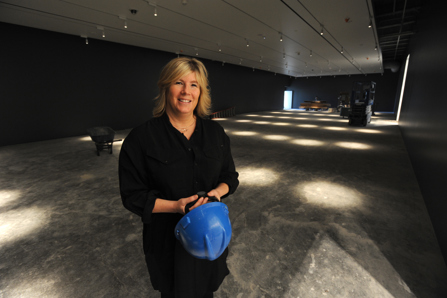
Anchorage Museum Director and CEO Julie Decker
Julie Decker is the Director and Chief Executive Officer of the Anchorage Museum in Anchorage, Alaska. The museum stands on indigenous land considered as periphery in global terms. For Julie, periphery is relative. “Perceived peripheral places have a much deeper connection to communities …” Julie tells us, “alternative voices were always on the side… now that is changing”.
Julie takes us on a trip down memory lane to when she practised as an artist and gallerist. She also speaks fondly of her first encounters with the Anchorage museum, thanks to her Dad, an artist too, who was also an art teacher, who also instilled in her an instinct for close observation that would become a habit of noticing the small things. This, I believe, is also foundational to how the Anchorage now positions itself within its community.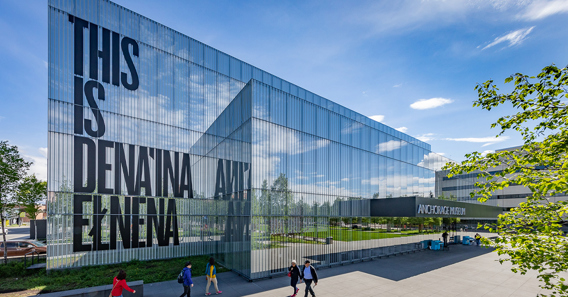
The Anchorage Museum's façade carries the message "This is Dena'Ina Homeland,"
written in the language of the local indigenous people's dialect.Julie’s vision for the Anchorage Museum is quietly radical. The museum must be useful and embedded in the present within its community. It has to serve the purpose of a place that enables people to tell stories too. It must show up, participate, and become part of the social fabric it seeks to engage. More importantly, it’s the how that makes all the difference. For the Anchorage Museum, that “how” can be an exhibition, but also a podcast, a record or a newspaper article.
“From musical albums to supporting film makers to supporting writers writing books or partnerships with local newspapers - no issue with the form that our projects can take”, Julie quips, but to do so, the museum has to be an active listener with nothing cast in stone. Julie’s experience is very telling in this respect. “… we have proven that being really fluid and adaptable is much more promising than our own assumptions.” That statement reminded me very much of a liquid museum, taking the shape and form that circumstances indicate, and going with the flow. The skills to do that are all about being present in the community rather than reaching out.
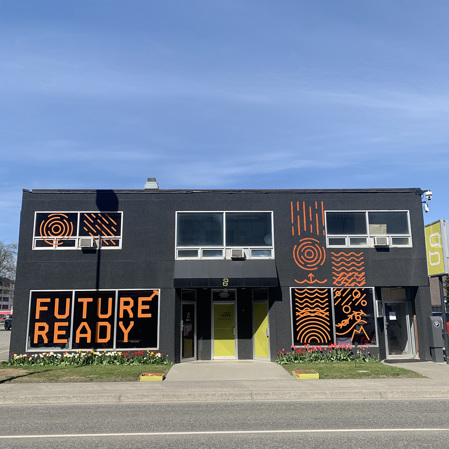
The Seed Lab, in Downtown Anchorage, functions as a
community-minded creative space run by the Anchorage Museum.The Seed Lab Project, where the Anchorage museum is both listener and convener, is one such project that walks the talk. Seed Lab is a community space and creative hub run by the Anchorage Museum in partnership with the Municipality of Anchorage. Seed Lab was deliberately left open-ended at the outset, on the principle that over-definition is itself a constraint. The space is designed to follow the momentum of its community rather than a predetermined programme, and has evolved into something genuinely animated and generative in character. Seed Lab brings the Anchorage one other step closer to engaging beyond the space, literally out of the box and puts into practice the idea that the Anchorage museum has always been thought of as a community sitting room. I would consider Seed Lab as a third space, situated between home and the museum, with the potential to inform the museum’s programming and outreach over the long term.
Moving beyond the perimeter of the museum box is the challenge that the Anchorage museum is engaging with. Such a step forward might go beyond Seed Lab, potentially in more than one direction. Alaska’s geography and way of life would inform an even greater community grounding. Alaska's relatively small population means that individual initiative can ripple unusually widely. Julie sees this as an asset rather than a limitation. Indeed, this can go way beyond local communities and Alaskans. That is very much true about Julie’s work, but not just, as she rightly claims, “If we can be useful to the people that live here, then I think we have a story to tell people around the globe.”
Alaskans do hold meaningful and impactful stories to tell to the world and that resonates much more with topics such as climate change, which Alaskans witness directly every day. Julie goes deeper into this topic, discussing food systems, sustainable communities and how changes in nature affect community systems and securities. In such places as Alaska, where practically everything has to be imported, climate change takes on even more new meanings. More of that in the podcast.
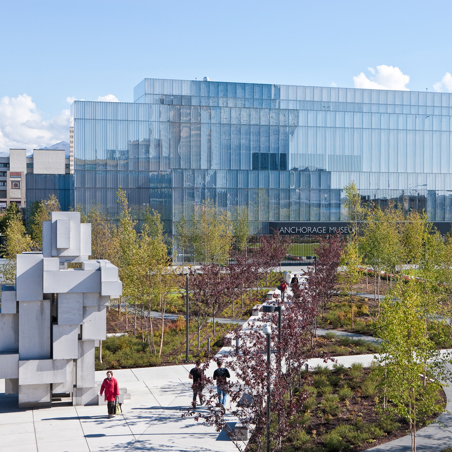
The Anchorage Museum (circa 2010)Julie’s reflections are about hope and if there is one thing that I would take away from this conversation, it would be about the relevance and resonance of peripheries. Centers will shift as climate change progresses, and peripheries might yet become centers. Alaska might still be a periphery but that does not hold it back from looking forward, ahead and beyond. We might have lost our ability to talk about futures, perhaps stuck in an alarmist mindset that holds us back from being hopeful. Museums are there to think about the unthinkable, the different and the far better than we might perceive or envisage.
Julie’s statement sums it up nicely.
“We celebrate the perceived periphery of our place as … a new centre of ideas”
Listen to the podcast in its entirety here.
As you listen to this podcast, you will hear Julie mention ideas, reference concepts and discuss much more in detail. Should you wish to explore further, these are some links to the things that get mentioned:
The Anchorage Museum
How the Anchorage Museum is Telling the Story of Climate Change
Seed Lab
Bloomberg Philanthropies