







Museum Futures

The Dunkleosteus Fossil at the Cleveland Museum of Natural History.
Museum Future
Conversations with Elizabeth Merritt, Founding Director of the Center for the Future of Museums within the American Alliance of Museums.
by Sandro Debono
Season Two of the ‘Museums in a Climate of Change’ has taken us far and wide as we continue to explore the latest thinking around climate and change. Dr. Sandro Debono, a museum thinker based on the Mediterranean island of Malta, shares his thoughts and reflections about this series of podcasts, now in its second season, featuring conversations with museum professionals from all over the world, co-hosted with Cody Liska.
What if the future of the museum was not something to be feared, but something to be designed?
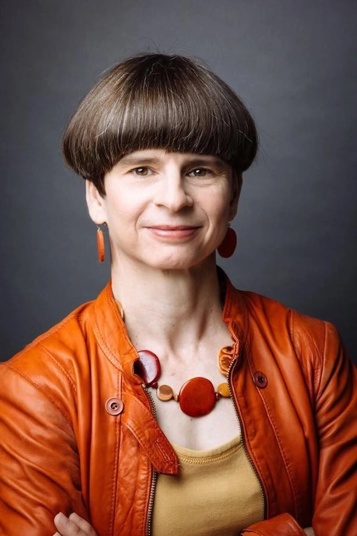
Elizabeth Merritt, Director/Founder of the Centre for
the Future of Museums, American Alliance of Museums
I think this question stands for a good synthesis of our conversation with Elizabeth Merritt, Founding Director of the Center for the Future of Museums. Elizabeth presented herself in one of the most clear and straight-to-the-point introductions we got throughout the series: "I am the national futurist for US museums, and my job is to try to detect trends and events that may have an effect on their communities and on their operations... I'm looking for hints of where things could go in a significant way," she said.
Elizabeth spent the better part of two decades reading widely, thinking deeply, and helping museums find their footing in a world that refuses to hold still. This does not mean telling museums what they "should" do but, rather, what they "can" do. Elizabeth did make this distinction, and clearly so.
Elizabeth's work is guided by futures thinking and strategic foresight to systematically explore how the world might change over time. Futures thinking frames a disposition to engage with the future to address the challenges of the present. The goal is to develop the cognitive flexibility to navigate multiple plausibilities, making museums more resilient, more adaptive and better positioned to shape the conditions they want to see, rather than merely react to conditions coming their way.
Elizabeth's answer to the question of how museums related to time is to say that museums exist simultaneously in three horizons of time, challenging our understanding of the past, helping people make sense of the present and informing the uncertainties of the future that are equally present in the past. The most powerful way to build the future you want is to imagine you are already living in it and then trace back how you got there. Museums, Elizabeth suggests, are natural homes for this kind of imaginative reversal. "Museums are the nearest that we have to functional teleportation devices" she said. Indeed, they move us across time. They make us feel the weight of what has been and the possibility of what could be. And in doing so, they do something no algorithm yet manages: They make meaning feel earned.
"I read omnivorously... I am a whale shark for the museum sector," Elizabeth confidently tells us, and, for that matter, the reading list is quite exhaustive. Her choice, however, " depends on whether you're talking about just expanding your imagination about what the future could be like or whether you're looking for hope and optimism." What particularly inspires Elizabeth is science fiction. Cody and I were quite intrigued by that statement. For Elizabeth, speculative fiction is a rehearsal space for the futures we might actually want. But that is only part of the story.
Elizabeth trawls oceans of information ranging from research reports and news feeds to social media and science fiction, filtering out the good bits to pick feeble signs of trends that would then inform her Dispatches from the Future, as she fondly calls her regular weekly writings. In doing so Elizabeth has to proceed with caution and strategy. Narrowing too soon would make her pick one loud signal as if it stands for a whole symphony. That is the job of a futurist too. 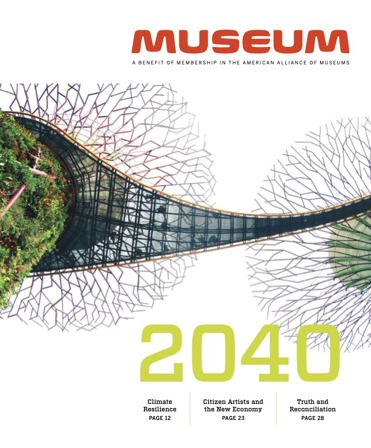
The 2018 Trendswatch Special Edition
(American Alliance of Museums website)
Throughout this conversation, we got to know a little bit more about the history of the Center of the Future of Museums that she co-founded and leads, but, perhaps more importantly, her insights on Trendswatch, the Center's annual synthesis of the forces reshaping the museum landscape. I could not hold back from sharing my favorite edition with Elizabeth. That was the 2018 special edition was written as if from the year 2040. Plausibly living over thirty years ahead led contributors to imagine possibilities that would have challenged the present circumstances in varied ways.
As expected, climate change also came up in our conversation. The challenge, Elizabeth argues, is not only one of rising seas or shifting seasons. It is the compounding speed of change that museums and their communities are struggling to absorb. Despite this, Elizabeth did not come across as resigned in any way. She finds hope in museums that are stepping up, particularly with regard to adaptation and community support. When you think about it, museums are comfortably positioned to take on this challenge. "If you've spent a hundred years figuring out how to take care of your art and your historic artefacts, despite anything that happens," Elizabeth observes, "you can also take care of your neighbors." That was one of the most elegant yet pragmatic formulations of the case for the socially engaged museum that I have heard.
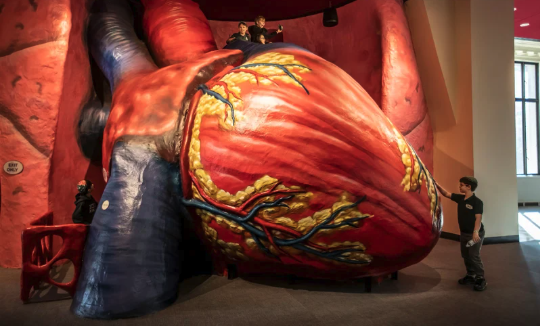
The iconic walk-through Giant Heart Exhibit at the Franklin Institute in Philadelphia,
mentioned by Elizabeth in her conversation.
There is no question that Elizabeth is in love with museums and has been so ever since her childhood days. As our conversation unfolded, museum after museum kept coming up as case studies and best practices, comfortably cited with the knowledge of someone who knows these places first-hand. There are also challenges to engage with. Back in 2025, when Cody and I hosted Elizabeth, "the most acute challenge for museums in the face of current US government policies may be how to be economically sustainable and how to be intellectually independent in the face of all of the disruptions we're facing ..." This might still be the case. Indeed, the challenge ahead lies in how museums can remain economically sustainable and intellectually independent, and more importantly, how they can hold on to public trust.
But what does the future hold for museums? To start off with, the museum idea shall continue to morph and evolve. "I think what we're going to see in the coming years is more and more different ways of being a museum. And maybe there is no definition of what a museum is." Elizabeth offered. The museums that shall hold futures relevance would be the ones that embed an ambition to create a better world for future generations, that ask, as she puts it, what a child born in fifty years will look back and thank them for in their vision statements. That is a form of generational responsibility that the museum, with its deep roots in time, is unusually equipped to model.
That is, more than anything else, a statement of hope.
Listen to the podcast in its entirety here.
As you listen to this podcast, you will hear Elizabeth mention ideas, reference concepts, and discuss much more in detail. Should you wish to explore further, these links take you to the people, projects and places that get mentioned:
Centre for the Future of Museums
Trendswatch
Institute for the Future
Cleveland Museum of Natural History in Ohio
Neon Museum in Las Vegas
Louisiana’s Children’s Museum in New Orleans
Charles H. Wright Museum of African American History in Detroit
Children’s Museum and Nature Center
Japanese American National Museum in Los Angeles
Nevada Museum of Art
The International Museum of Art and Science in McAllen, Texas
National Public Housing Museum in Chicago
The Dunkleosteus fossil at the Cleveland Natural History Museum
The Giant Heart at the Franklin Institute in Philadelphia
Our Epidemic of Loneliness and Isolation: The U.S. Surgeon General’s Advisory on the Healing Effects of Social Connection and Community
The Five Types of Dystopian Narrative
'The Ministry for the Future' by Kim Stanley Robinson (Book)
‘The Parable of the Sower’ by Octavia E. Butler (Book)
‘A Psalm for the Wild-Built’ by Becky Chambers (Book)
Philip K. Dick, short story writer and novelist
Ray Bradbury, American author and screenwriter