








7 Things Anchorage Locals Might Notice in Everyday Anchorage: Duke Russell & Ward Wells
May 5, 2026
Looking at the city through the paintings of Duke Russell and the photographs of Ward Wells:
Anchorage changes quickly. Buildings disappear. Neighborhoods evolve. Trees grow tall where open views once stretched across town. Much of that change is held in the Anchorage Museum archives, where photographs, records, and personal histories trace how the city has taken shape over time. The Ward W. Wells Collection is a central part of that record. Over four decades, Wells, a commercial photographer, created an extensive body of work reflecting life in Anchorage and across Alaska, capturing everything from downtown storefronts and local businesses to celebrations, performances, and everyday street scenes.
Everyday Anchorage brings that archive into conversation with the work of painter Duke Russell. After multiple visits to the Museum’s archives to study Wells’ images, Russell began using them as inspiration alongside his own memories to create paintings that feel both specific and familiar. The exhibition opens up the archive in a new way, connecting past and present through places many people still recognize.
The Artists Behind the Work
Duke Russell (b. 1959) moved to Anchorage at age 12 and has spent much of his life in Spenard. A self-taught artist, he developed his technical skill through work in film and theater. His paintings draw from Alaska’s past and present, often focusing on people and places that might otherwise be overlooked. Many begin in memory or in the archives, then shift into something imagined but still grounded in lived experience.
Ward Wells (1920–1982) arrived in Alaska in 1946 and opened a photography studio in Anchorage the following year. For more than three decades, he documented life across the state. His photographs range from downtown street scenes and local businesses to Fur Rendezvous, statehood celebrations, and the aftermath of the 1964 earthquake. His work appeared in national publications such as Life and Time, while also serving as a visual record of everyday life in Anchorage.
1. ROCKET PARK BEFORE THE TREES
Many people know Valley of the Moon Park as Rocket Park. Today, it is surrounded by tall trees.
In Ward Wells’ photograph from 1974, the rocket stands in a much more open setting. Anchorage’s trees have grown significantly over the past 50 years. Looking at older photographs can make that change surprisingly clear.

Ward Wells, Ward W. Wells Collection, Anchorage Museum, B1983.091.S5322.01

Duke Russell, Rocket Park, 2013. Acrylic on canvas. 35 x 60 inches. Collection of Peter Nosek.
2. DOWNTOWN ANCHORAGE ON A RAINY NIGHT
Wells photographed 4th Avenue in October 1957, capturing the glow of streetlights reflecting on wet pavement.
Anyone who once walked downtown past the the historical 4th Avenue Theatre will appreciate the scene: quiet streets, reflections in the road, and a slower version of the city.

Ward Wells, Ward W. Wells Collection, Anchorage Museum, B1983.091.S1849.1
3. The Kut Rate Kid sign
For many longtime residents, the Kut Rate Kid sign is instantly recognizable. Pictured here, Wells photographed the storefront on Fireweed Lane in 1966.
Russell later recreated the image in a painting, working from a worn Polaroid photograph. The process became a way of restoring a small but meaningful piece of Anchorage history.

Ward Wells, Kut Rate Kid at 700 E. Fireweed Lane, 1966. Ward W. Wells Collection, Anchorage Museum, B1983.091.C7009.01

Duke Russell, Kut Rate Kid, 2012. Acrylic on canvas. Private collection.
4. Club Paris, then and now
Ward Wells photographed the interior of the newly opened restaurant Club Paris in 1958. Looking at the image today, the space feels familiar to Anchorage residents who eat at the still popular local restaurant.
Russell remembers visiting as a kid and being fascinated by the painted Paris street scene behind the bar. Restaurants like this often become part of people’s personal timelines. First dates, celebrations, late meals after a night out.
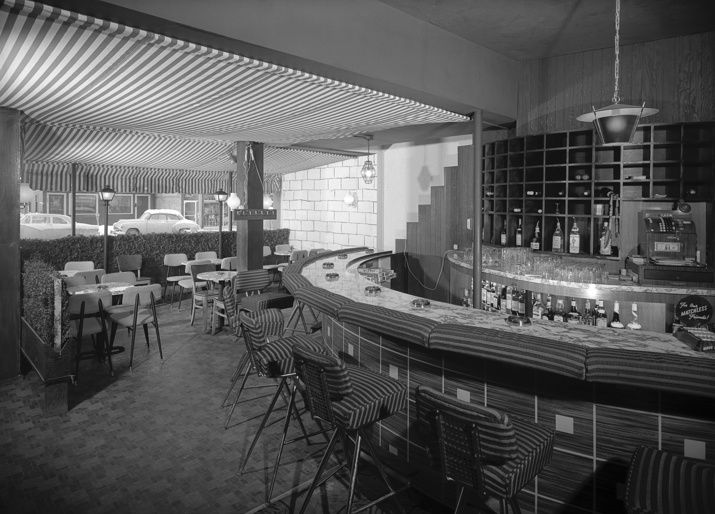

Duke Russell, Club Paris, 2003. Acrylic on panel. Private collection.
5. Walking down 4th Avenue
Russell’s painting Walkin’ 4th Avenue captures the energy of downtown car and foot traffic.
He painted the buildings first. The people came later over the course of three months. He stood on the sidewalk across the street to accurately record each figure and detail in the scene.

Duke Russell, Walkin' 4th Avenue, 1995. Acrylic and Bristol board on Masonite. Private collection.
6. Grocery stores as neighborhood theater
Grocery stores once leaned into spectacle.
Ward Wells photographed elaborate displays at Carrs in 1953, including costumed promotions and live turkeys meant to draw shoppers inside. Russell’s painting Little Buddha Shopping Carrs reflects the humor and observation that come from watching everyday life unfold in these neighborhood shops.

Ward Wells, Carnation Milk display at Carrs with Gregory Carr, son of the proprietor, as the "King of Carrs," 1953. Ward W. Wells Collection, Anchorage Museum, B1983.091.C0585.1

Ward Wells, Live turkey and cranberry display at Carrs, 1953. Ward W. Wells Collection, Anchorage Museum, B1983.091.C0813

Duke Russell, Little Buddha Shopping Carrs, 1994. Acrylic on panel. 48 x 64 inches. Collection of Carol and Alex Bryner.
7. The first escalator in Alaska
In 1961, Wells photographed shoppers riding what was reportedly Alaska’s first escalator at the Northern Lights Shopping Center.
For children at the time, it was a novelty worth riding again and again. Today, the photograph feels like a snapshot of a city stepping into a new era of development and modern retail.

Ward Wells, Shoppers ride the first escalator in Alaska at Caribou's in the Northern Lights Shopping Center, 1961. Ward W. Wells Collection, Anchorage Museum, B1983.091.C4767.5
History in Anchorage is not only found in major events or well-known landmarks. It lives in parks, restaurants, storefronts, and neighborhood streets.
By placing Russell’s paintings alongside Wells’ photographs, Everyday Anchorage invites visitors to slow down and notice the details of the city. Many of these places still exist. Others survive only in photographs and memory. Together, they tell a story of a city that has always been changing, they tell a story of a city that has been shaped by change and memory.
Everyday Anchorage: Duke Russell & Ward Wells is on view beginning May 1, 2026. Take an audio tour narrated by Duke Russell HERE.